Volunteer
Volunteering: Developing People
Engineering has given me a career I have loved, but alongside developing technology there has always been another important part of my journey – developing people.
I first became involved in volunteering through professional engineering organisations, initially as a way to learn, meet people and give something back. Over time it became a significant part of my life. It has given me opportunities to create initiatives, mentor engineers, encourage young people into STEM, connect industry with education and help shape the engineering profession.
A recurring theme throughout my volunteering has been creating opportunities for others. Some are opportunities I wish I had known about earlier in my own career; others simply came from seeing something that could be better and deciding to do something about it.
I have gained just as much from volunteering myself – new skills, confidence, friendships and experiences that have influenced both my career and the way I lead.
Women in Engineering
My involvement with the Women's Engineering Society (WES) began almost by accident. While undertaking my Engineering Doctorate, I attended a Women in Engineering breakfast at a conference in San Francisco. I enjoyed meeting other women engineers and, when I returned home, looked for something similar in the UK. That search led me to WES.
I attended a WES conference near Edinburgh and it changed the direction of my career. I became increasingly involved with the Society, eventually serving as a Director and Trustee and, in 2013–14, as President.
As President and later Past President, I represented WES at events across the UK and internationally, including speaking engagements in Los Angeles and Amsterdam. I also represented the Society at STEM and engineering discussions at 10 Downing Street, the House of Commons and the Scottish Parliament.
Through WES I had the opportunity to turn ideas into action. I managed the Doris Gray Awards in Scotland, created the WES Female Student Conference, helped establish Girls into Physics and led the project to digitise The Woman Engineer.
My involvement with WES introduced me to an extraordinary network of women engineers and gave me opportunities to encourage others at every stage, from school pupils considering engineering for the first time to experienced engineers developing their careers.
Many of the initiatives I became involved with through WES are described later on this page, because their stories – and the people behind them – deserve more than a line in a list of roles.
The Institution of Engineering and Technology
I joined the Institution of Engineering and Technology (IET) while undertaking my Engineering Doctorate, initially seeing membership as a way to support my own professional development. I soon became involved in volunteering locally, and that involvement grew into leadership roles across Scotland and eventually within the wider Institution.
My roles have included Chair of the IET Scotland South East Local Network, Chair of IET Scotland, Chair of the Engineering Policy Group Scotland and Chair of IET Council – in each case, I was the first woman to hold the position. I later became an IET Trustee and Vice President, giving me the opportunity to contribute to the governance and strategic direction of the Institution.
I have also represented the IET externally on a number of occasions, including at the Scottish Parliament and formal engineering dinners, and was asked to represent the IET President at an event at the Edinburgh International Conference Centre.
Supporting other engineers has been an important part of my IET volunteering. I have been involved in Professional Registration and Fellowship as an advisor, interviewer, assessor and mentor, helping engineers reflect on their experience, recognise what they have achieved and take the next step in their professional development.
As Chair of the Volunteer Engagement Board, I also focused on improving the experience of IET volunteers. This included work on changes affecting around 4,000 volunteers, helping ensure that the Institution supports its volunteers while meeting its governance and training responsibilities.
What began as something I thought would help my own professional development has given me far more than I expected. Through the IET I have developed new skills, built confidence, formed friendships and professional networks, and had opportunities to contribute to both the engineering profession and the development of other engineers.
Trustee and Board Roles
Alongside my work with WES and the IET, I have had the opportunity to contribute to a wide range of organisations through trustee, board and advisory roles.
My engineering and industry roles have included the National Manufacturing Institute Scotland (NMIS) Board, serving as Trustee and Honorary Treasurer of Engineering Scotland, as a Trustee of the Institution of Engineers in Scotland (IES), and on the Association for Black and Minority Ethnic Engineers (AFBE) Advisory Board. I have also served as Vice President of the Royal Scottish Society of Arts (RSSA) and I am now Co-chair of the Equate Scotland Steering Committee.
My volunteering has also taken me into some of Edinburgh's historic organisations. In 2019, I became the first female Deacon of the Incorporation of Hammermen of Edinburgh, one of the city's ancient Incorporated Trades.
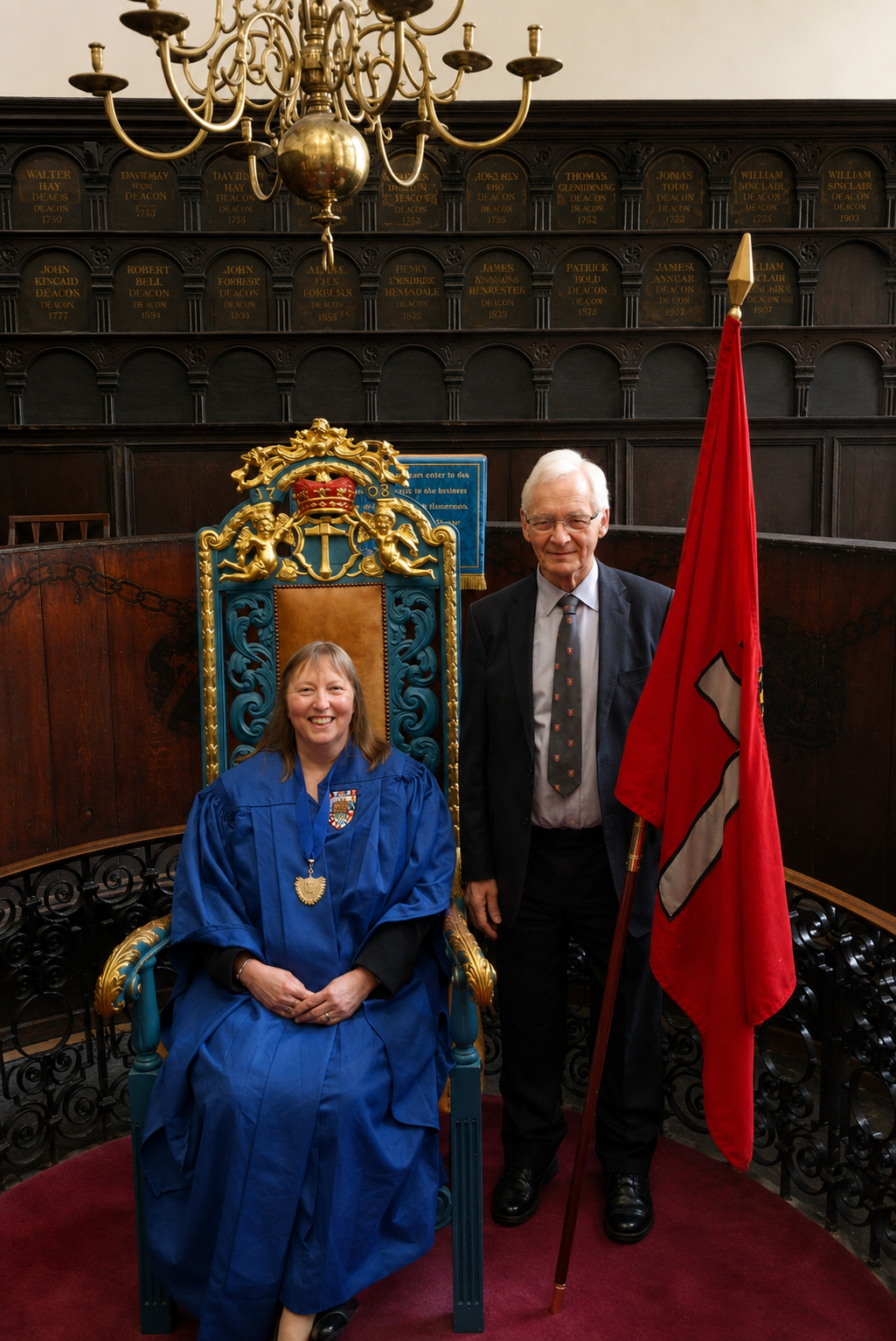
During my time as Deacon, I also served as a Trustee of the Edinburgh Trades Fund and as a member of the Convenery of Edinburgh Board. I subsequently became Boxmaster of the Hammermen and a member of the Burgess Court.
These roles have given me the opportunity to contribute beyond my own engineering specialism, bringing my experience of industry, leadership and governance to organisations with very different purposes and histories.
Supporting the Engineering Profession
I contribute to the wider engineering community through judging, peer review and conference programme committees, using my experience to help recognise achievement and support the sharing of engineering knowledge.
Judging Engineering and STEM Awards
Since 2014, I have been invited to judge a wide range of engineering and STEM awards and competitions, covering engineering innovation, young engineers, diversity, technical skills, education and volunteering.
These have included the IET Young Woman Engineer of the Year, AFBE Young BME Engineer of the Year, TechWorks Innovation Awards, Institute of Physics Technician Skills Awards, FIRST LEGO League, Primary Engineer, Novi STEM Leadership Award and the Royal Academy of Engineering Amazon Future Engineer Scholarship.
Some have become long-term commitments. I have judged the RAEng Amazon Future Engineer Scholarship since its inception, and have continued to support several other awards over successive years. I particularly enjoy judging because it gives me the opportunity to see the breadth of engineering taking place and to recognise the achievements of people at different stages of their careers.
Peer Review and Programme Committees
I have been invited to peer review engineering papers for international conferences and journals, contributing my industry and technical experience to the assessment of new research.
I currently contribute to the International Federation for Information Processing (IFIP) SEC International Conference on Information Security and Privacy Protection and IEEE HISTELCON , the IEEE international conference focusing on the history of electrotechnology.
I have also served on international conference programme committees, including the Southern Conference on Programmable Logic, where I was a Programme Committee member from 2007 to 2015.
These activities allow me to contribute to the profession in a different way – by helping recognise good engineering, supporting the sharing of technical knowledge and giving something back to the engineering community.
Mentoring & Developing Engineers
Mentoring has become one of the most rewarding parts of my volunteering. I enjoy helping engineers recognise what they have achieved, build confidence in their own abilities and decide what they want to do next.
A significant part of this has been supporting engineers with Professional Registration and Fellowship. Since 2020 alone, I have supported more than 100 engineers with Professional Registration and more than 30 with Fellowship, helping them understand the requirements, review their experience and prepare their applications and interviews. These figures do not include the many engineers I mentored earlier in my career or through my technical and leadership roles.
One example is Dr Junade Ali CEng FIET, who became the IET's youngest-ever Fellow. In his IET profile, he credited me as his Fellowship Adviser and said I “did an amazing job of guiding me through the process and helping me to put together my application for review.”
Not everyone I mentor is ready to apply immediately. Sometimes the most useful advice I can give is that they need more experience first, together with guidance on what they can do to develop. For me, mentoring is not simply about completing an application; it is about helping someone understand where they are, where they want to go and how they might get there.
My mentoring extends well beyond professional recognition. Throughout my career I have supported graduates, engineers and emerging leaders as they developed technically and professionally. Some of the graduates I recruited and mentored earlier in my career are now technical leads, project managers and senior managers.
One of the things I have learned is that mentoring does not always require complicated advice. Sometimes the most valuable thing you can do is listen, ask the right questions and encourage someone to have confidence in themselves.
STEM, Education & Academia
Supporting young people and strengthening links between education and industry have been important parts of my volunteering.
I have been a STEM Ambassador since 2007, taking part in activities ranging from careers events and science festivals to engineering competitions and practical STEM challenges. Over the years I have supported initiatives including F1 in Schools, GO4SET, FIRST LEGO League and Rampaging Chariots, as well as other events designed to give young people direct experience of engineering and technology.
My work with universities has also grown over time. I was a Royal Academy of Engineering Visiting Professor at Edinburgh Napier University and, following the completion of that appointment, became a Visiting Professor at the University.
I am also Chair of its Engineering and Mathematics Industrial Advisory Board, helping to build enduring links between industry and academia and ensuring students are exposed to the skills, technologies and opportunities they will encounter in professional engineering.
A recurring theme in this work has been building enduring links between industry, academia and the next generation of engineers.
Organising Events & Creating Opportunities
Organising events has been an important part of my volunteering. Some began with a particular problem I wanted to address, others grew from collaboration with other organisations, and many simply provided opportunities for engineers to meet, learn and share their experiences.
WES Female Student Conference
One of the first major events I created grew from a statistic that concerned me: five years after graduating, only 21% of female engineering graduates were still working in engineering.
I wanted female engineering students to see the breadth of careers available to them and to meet women already succeeding in the profession. In 2009, with support from the Doris Gray Fund, I founded the first WES Female Student Conference in Edinburgh.
The inaugural two-day conference attracted 45 students. I continued organising the conference until 2015, during which time it grew substantially. By 2015, 175 people attended over the two days, including 122 students from 30 universities. Twenty-five companies and organisations contributed, there were 25 speakers and nine sponsoring companies, with £31,000 of company sponsorship.
Conference programmes: 2009 | 2012 | 2013 | 2014 | 2015
The conference brought students together with engineers from across the profession, giving them an opportunity to hear about different careers, build networks and see a future for themselves in engineering. It continued beyond my involvement and developed into an annual national WES event.
Girls into Engineering
In 2014, to mark the first National Women in Engineering Day, I created Girls into Engineering, working with three local primary schools in areas where I particularly wanted girls to have greater exposure to engineering.
We invited all the Primary 7 girls from the schools to spend a day in an engineering workplace during their final week of primary school. Rather than simply telling them about engineering, I wanted them to experience it for themselves.
The girls took part in a range of practical engineering and STEM activities, including FIRST LEGO League, Rampaging Chariots , Lighting up the Curriculum , rockets, building bridges and a site tour. Around 40 girls attended the first event, increasing to around 60 in later years depending on the size of the school classes.
The Edinburgh event became an annual programme which I continued to organise, while other sites within the company also began running events for girls as part of the wider initiative.
The programme also helped build relationships with the schools and their teachers. One teacher became her school's STEM contact, helping engineering activities continue beyond the event itself.
In 2015, the Edinburgh event received a very special visitor when His Majesty King Charles III, then HRH Prince Charles, Duke of Rothesay, joined the girls during their engineering activities. That year's National Women in Engineering Day Impact Report documented the Edinburgh programme and named me as the contact. Around 40 Primary 7 girls took part and the then Prince Charles spoke to more than 75% of them. The visit also generated four newspaper and five digital articles.
By 2019, I had handed responsibility for organising the Edinburgh programme to a younger generation of women engineers. When COVID prevented the usual events from taking place, the team adapted the programme and delivered activities online.
Helping to Establish Girls into Physics
In 2009, while planning the first Doris Gray Student Conference, I wanted to run a STEM event for schoolgirls alongside it. The Director of Equate Scotland introduced me to the Institute of Physics (IOP), who in turn introduced me to a physics teacher at George Watson's College. From those discussions, Girls into Physics was born.
The teacher organised the event, with funding from the Doris Gray Fund. The first event brought together 90 girls from schools across the Central Belt for physics and engineering activities. What began as an afternoon event developed into a larger programme involving several schools. The IOP subsequently expanded Girls into Physics to other regions of Scotland.
This was also the beginning of a long-standing relationship with Equate Scotland. We subsequently worked together on National Women in Engineering Day events and other activities encouraging girls and women into engineering and technology.
Celebrating 100 Years of WES
In 2019, to celebrate the centenary of the Women's Engineering Society, I gave the annual IET Scotland Dinner a special focus on women in engineering. The dinner launched a wider IET Scotland programme celebrating Women in Engineering. The top table and speakers were all women, with Nina Baker giving the keynote presentation on the history of women in the IET.
I also wanted to bring some of that history to life. Four women engineers each chose a woman engineer from the past and, speaking from their tables, presented as that woman, while a photograph of the historical engineer appeared on screen.
Adapting During COVID
COVID disrupted two major events I was helping to organise, but in both cases we found a way for them to go ahead.
In 2020, I was organising my second IET Scotland Dinner, this time with STEM Education as its theme. The planned programme brought together speakers covering the IET education programme, STEM in Scotland and encouraging girls into computing. When the dinner had to be cancelled, we already had the speakers and programme in place, so rather than lose the event we turned it into an online STEM Education in Scotland event.
The following year, I worked with the Institution of Civil Engineers (ICE) to create an Engineering Climate Conference, bringing professional engineering institutions together around one of the major challenges facing society. Originally planned as a two-day live conference, it had to be postponed because of COVID. As we already had an excellent programme of speakers, we redesigned it as a one-day online conference, which took place in June 2021.
Supporting the Engineering Community
While Chair of the IET Scotland South East Local Network and later IET Scotland, I organised a wide range of events, including celebrations recognising IET members in Scotland who had achieved professional registration, Fellowship or scholarships, professional registration events and training, technical talks and networking events.
Preserving Women's Engineering History
Some of my volunteering has involved preserving the stories and history of women in engineering. Two projects in particular remain important to me.
Dr Doris Edna Gray (1915–2004)
Dr Doris Edna Gray was born in Guelph, Ontario, Canada, in 1915. She studied General Science before completing an MSc and PhD in Biochemistry at the University of Western Ontario, where she subsequently became a research fellow.
In 1953 she joined the Department of Biochemistry at the University of Hong Kong as a Lecturer, progressing to Senior Lecturer and later Professor. By 1963 she had already published 18 academic journal articles. She retired from the University in 1975.
A friend of Doris later told us that, after retiring, she fell in love with a Scotsman and moved to Dunblane in Scotland, where she spent the rest of her life. She died there in 2004 at the age of 88.
Although Doris had built a distinguished career as a scientist, she had always wanted to be an engineer. She became an Associate Member of the Women's Engineering Society in 1984 and was active in its Scottish Circle.
On her death she left £100,000 to the Women's Engineering Society, to be spent over ten years encouraging and promoting women in engineering. Her generosity established the Doris Gray Fund and enabled projects whose influence continued long after the original funding ended.
I was responsible for managing the Doris Gray Awards in Scotland. The fund supported women continuing their engineering degrees and helped make possible initiatives including the first WES Female Student Conference, the first Girls into Physics events and the creation of the Equate Scotland Female Student Network.
Preserving The Woman Engineer
The Women's Engineering Society published the first issue of its journal, The Woman Engineer, in 1919. Together, its issues provide a remarkable record of the achievements of women engineers and the changing role of women within the profession.
By 2015, the historic journals were held in the IET archives in London, while more recent issues were available online. I wanted the earlier material to be equally accessible, so I raised the funding and led a project to digitise the historic archive.
The project was made possible through the generosity of several supporters. Anne Royle left WES a legacy of £2,500, the Royal Academy of Engineering contributed £1,000, and further personal donations helped complete the funding. The IET provided invaluable support with the digitisation and hosts the archive online.
I also made a small personal contribution, choosing to sponsor issues from 1992 and 1996 – the years my two sons were born.
The completed digital archive made decades of WES history freely accessible, allowing engineers, historians, researchers and anyone interested in the history of women in engineering to discover the women who helped shape the profession and to see how opportunities for women have changed over more than a century.